
As of January 1, 2026, the connected V16 beacon is the only legally mandatory device for signaling a broken down or immobilized vehicle on public roads in Spain. This measure is backed by data, endorsed by the Directorate-General for Traffic, and promoted with the aim of reducing road fatalities.
In this article, we analyze the technical, regulatory, and road safety context that has led to its implementation, as well as the requirements that a V16 beacon must meet in accordance with current regulations.
Why was the V16 beacon made mandatory?
The decision is based on accident data linked to the placement of emergency triangles. According to official figures from the Directorate-General for Traffic:
- 159 people died between 2018 and 2024 after getting out of their vehicles to place the triangles.
- An average of 24 drivers died per year for this reason.
- In 2025, 103 pedestrians died in run-over accidents on interurban roads.
This problem, which has been highlighted for years by road safety operators and roadside assistance services, prompted a legislative response that culminated in the approval of Royal Decree 159/2021 of March 16, which established the mandatory nature of the connected V16 beacon as of January 1, 2026.
- 159 fatalities after exiting vehicles between 2018 and 2024
- 24 average annual fatalities
- More than 100,000 activations registered by February 15, 2026
- 2,300 average daily activations in Spain
What changes compared to emergency triangles?
Emergency triangles ceased to be mandatory on motorways and dual carriageways as of July 1, 2023, precisely because of the risk involved in walking on the hard shoulder to place them.
The V16 beacon completely eliminates the need to leave the vehicle to signal an incident.
It is important to remember that the vehicle evacuation protocol has not changed: if there is a safe place, the driver must move away from the vehicle; if there is none, they must remain inside.
5 technical advantages of the V16 beacon over triangles
1. Placement without leaving the vehicle
The device is placed from inside the vehicle, usually on the roof using a magnetic base. This dramatically reduces the risk of being run over or involved in a collision.
2. Virtual visibility: connectivity with the DGT 3.0 platform
When activated, the beacon transmits the vehicle's location to the DGT 3.0 platform. This information can be disseminated to other drivers through traffic panels and navigators connected to the National Access Point.
3. Greater physical visibility
The luminous signal is located at the highest part of the vehicle, providing 360° visibility and a range of up to 1 km in optimal conditions.
4. Effectiveness in adverse conditions
The luminous intensity and optical design allow the immobilized vehicle to be identified even in fog, rain, or low visibility.
5. Inclusive design
The system is especially useful for people with reduced mobility, older drivers, or users traveling with minors, as it avoids having to leave the vehicle.
Technical operation: connectivity, privacy, and autonomy
The connected V16 beacon incorporates Internet of Things (IoT) technology to transmit the location of the stopped vehicle to traffic management systems.
The technical characteristics defined by the DGT include:
- It does not permanently geolocate: it only transmits the location when activated.
- It does not transmit personal data of the driver or the vehicle.
- It does not require applications or prior registration.
- It operates autonomously and anonymously.
- Operates in tunnels and areas with low coverage using IoT networks.
- It functions as a light signal even without coverage.
- It can be used in countries that are signatories to the 1968 Vienna Convention on Road Traffic.
- The system has been validated by the Spanish Data Protection Agency.
Homologation: how to identify a certified V16 beacon
Not all devices available on the market are valid. For a V16 beacon to be legal, it must have passed a two-level certification process:
1. Tests in an accredited laboratory
Laboratories such as IDIADA or LCOE verify technical requirements such as:
- Luminous intensity
- Flash frequency
- Visibility
- Battery autonomy
- Resistance to temperature and humidity
- Connectivity
2. Production certification
The Automotive Certification Unit (UCA) and the Ministry of Industry oversee that manufacturers comply with technical requirements and conduct periodic production audits.
The Directorate-General for Traffic publishes the official list of certified devices daily under the heading "Certified brands and models".
Important: check that your beacon is the connected version
V16 devices purchased before 2021 may be non-connected models, which no longer comply with current regulations.
Always verify that your beacon:
- Appears on the official DGT list
- Has connectivity with the DGT 3.0 platform
The use of a non-homologated device does not comply with the legal obligation and may result in a penalty.
Legal framework: when, how, and where it is mandatory
| Aspect | Detail |
|---|---|
| Mandatory from | January 1, 2026 |
| Legal basis | Royal Decree 159/2021 of March 16 |
| Who must carry it? | Every driver traveling on public roads in Spain |
| When is it used? | When the vehicle becomes immobilized due to a breakdown or incident |
| Are triangles still valid? | They have been replaced by the connected V16 beacon as the mandatory system |
| Is it valid abroad? | Yes, in countries that are signatories to the 1968 Vienna Convention on Road Traffic |
| Are there controls? | The penalty applies if the vehicle is not correctly signaled |
Spain, a European leader in connected road safety
Spain is a pioneer in the implementation of the connected V16 device, a measure that is already being analyzed by other European countries for incorporation into their traffic codes.
This advance is part of the 2030 Road Safety Strategy, based on the concept of a safe system, which combines infrastructure, regulations, and technology to reduce the consequences of human errors.
In 2025, Spain recorded 1,119 fatalities on interurban roads, one of the lowest figures since 1960.
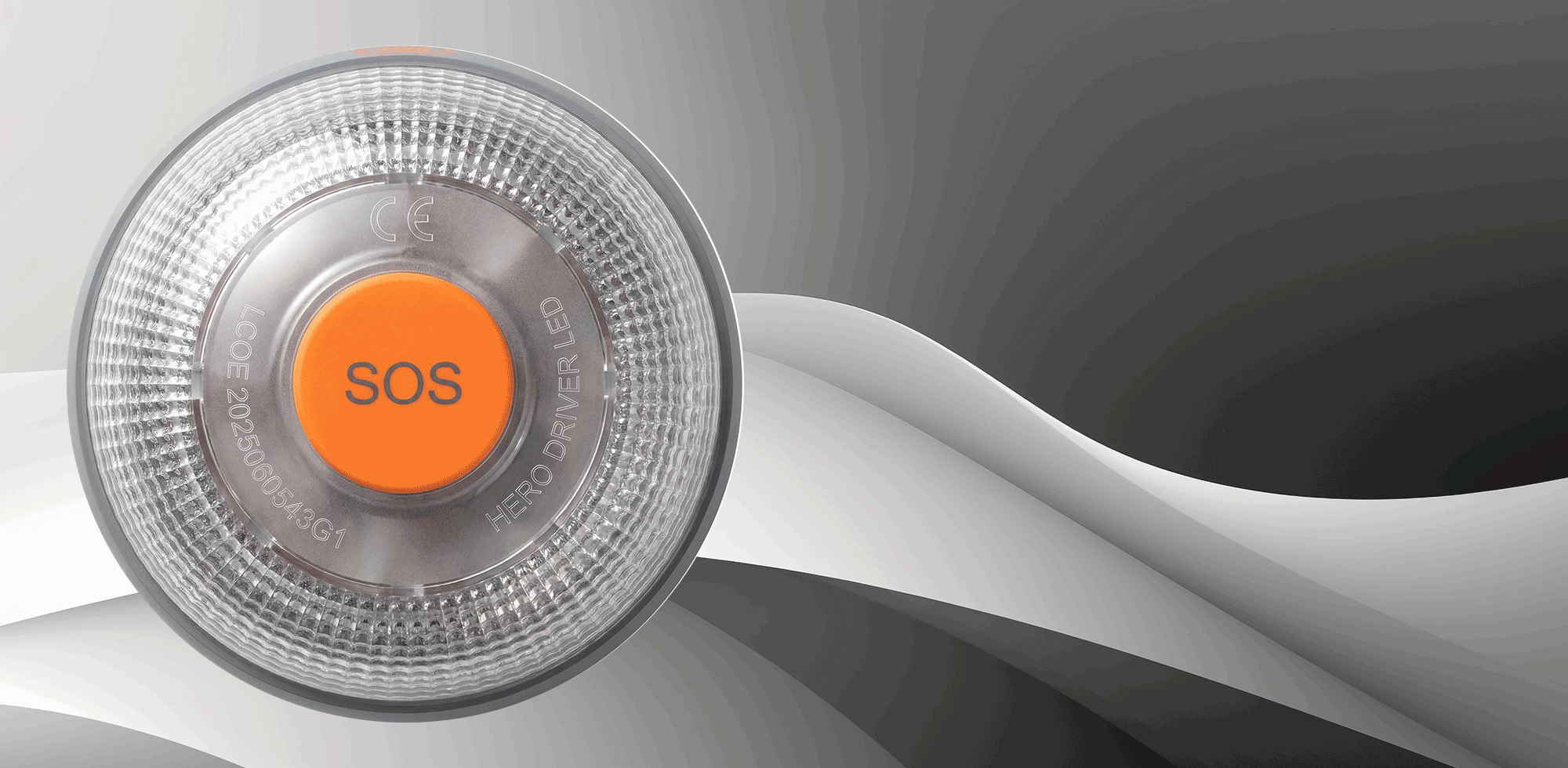
Hero Driver LED: certified connected V16 beacon
Hero Driver LED is a certified connected V16 beacon included in the official list of authorized devices by the Directorate-General for Traffic.
The device incorporates NB-IoT connectivity included until 2040, allowing it to automatically transmit the vehicle's location to the DGT 3.0 platform when activated.
Its features include:
- 360° visible luminous signaling
- Luminous intensity compliant with V16 regulations
- Resistance to adverse weather conditions
- Integrated connectivity with no additional fees until 2040
- Certification in accordance with current regulations
Frequently asked questions about the V16 beacon
Does the V16 beacon track my position permanently?
No. It only transmits the vehicle's location when activated by the driver.
Do I need to install an app?
No. Approved V16 beacons operate autonomously and do not require registration or apps.
Does it work in tunnels or areas without coverage?
Yes. It uses IoT networks designed to operate in difficult conditions. In the total absence of a network, the luminous signal continues to function.
Can I use it if I travel abroad?
Yes, in countries that are signatories to the 1968 Vienna Convention on Road Traffic, although the vehicle must always comply with the regulations of the country in which it is circulating.
Can I be fined if I don't carry a V16 beacon?
Yes. As of January 1, 2026, its use is mandatory when the vehicle is immobilized on the road and needs to be signaled.
Sources: statement by the Minister of Interior to the Interior Commission of the Congress of Deputies (February 25, 2026), 2025 Road Safety Balance of the Directorate-General for Traffic, and Royal Decree 159/2021.